Search This Blog

Showing posts with label Mike Rubin. Show all posts

Monday, October 5, 2026

Jazz For The Screen ★ Johnny Williams and Lionel Newman

"Jazz in the Movies" Collection
•
Johnny Williams 
The Music From "Checkmate"
and
Lionel Newman
The Music From "Hong Kong"


John Williams' musical roots—like his credits—are impressive. Long before this highly skilled musician scored and conducted the acclaimed music of several of the most successful films of the last four decades—Star Wars, Jaws, Superman, Close Encounters of the Third Kind, The Empire Strikes Back, ET: The Extra-Terrestrial, Indiana Jones and the Last Crusade, The Accidental Tourist, Schlinder's List, Raiders of the Lost Ark, Return of the Jedi, etc.—he was an elegant and swinging young pianist as well as an ambitious arranger/composer in the jazz and pop fields. That work gained him recognition in the Hollywood entertainment and recording scenes of the Fifties, when all the "cats" called him Johnny. In 1961 he composed the haunting background music of the popular TV series Checkmate. The modern brass arrangements he conducted were played by the top West Coast jazz studio musicians.
From the same time, Hong Kong is an exciting album spotlighting background music from the 1961 TV show composed by Lionel Newman. The material combined the style and form of the racy Peter Gunn music with the sounds of the Orient, music played firstly in the Hollywood tradition of lush string and brass scoring and in its second half by a swinging jazz nonet featuring Frank Beach, Abe Most, Bob Cooper, Paul Smith and Larry Bunker, all under the direction of Newman, and scored by some of the most in-demand Hollywood arrangers. *Jordi Pujol*

When these TV film soundtracks were recorded more than five decades ago, you couldnt walk about Hollywood without bumping into a musician or three: jazz musicians, swing musicians, studio musicians, who could play almost anything you wanted and in whatever key. They gathered there in California like wasps round a jam jar, for this was where they could make a living irrespective of what kind of music they wanted to play. Among the personnel are many names from West Coast jazz lesser-known names like Conrad Gozzo who nevertheless played with Shorty Rogers and others, and the very familiar Jimmy Rowles, big band stylist and accompanist of Peggy Lee etc. These soundtracks made for two TV series give an idea of what these jazzmen (and non-jazzmen) were brought into the studios to accomplish. It was not always jazz-as-we-know-it.
But the selection written for Checkmate, while clearly fashioned to accompany cinematic action, has a great affinity to the big band sound which was on the wane outside in the real world. Its certain that some of these compositions would not have worked without the powerful interpretation of jazz-oriented brass players. The composer Johnny Williams had been active for years as a jazz pianist recording with Buster Bailey and Eddie Durham, for example. There are passages in En Passant, say, with a rousing French horn ensemble when his creative mind seems to remember its writing for Tinseltown. But overall this is composing and delivery which swing listeners would find satisfying and absorbing.
I find it hard to say the same about the Hong Kong tracks which, lumbered by a sizeable string section, come across largely as romantic/dramatic film music, but very professionally played. You can almost imagine the rustle of popcorn packets. Presenting it as jazz is optimistic. Nevertheless, some charts are arranged by Marty Paich and Billy May, showing how Hollywood helped the jazz economy. And (point of interest) I'd never heard of a mokkin before, a Japanese 16-key xylophone, played by vibist Larry Bunker. *Anthony Troon (Jazz Journal)*


Music from "Checkmate"
Johnny Williams
(Originally issued on Columbia CS 8391)

1 - Theme from Checkmate
2 - The Isolated Pawn
3 - Cyanide Touch
4 - Far Out Place
5 - Hassle In The Castle
6 - En Passant
7 - The Black Knight
8 - Fireside Eyes
9 - The Bishops Retreat
10 - Queens Sacrifice
11 - Shy Youth
12 - The King Swings

(All compositions by Johnny Williams)

#1, #2, #7, #10:
Conrad Gozzo, Pete Candoli, Olie Mitchell (trumpets); 
Vince De Rosa, Dick Perissi, John Cave (french horns); 
Dick Nash, Lloyd Ulyate, Dick Noel (trombones);
Ronny Lang, Ted Nash (ato sax, fute); Gene Cipriano (tenor sax, flute); 
Chuck Gentry (baritone sax); Jimmy Rowles (piano); Bob Bain (guitar);
Joe Mondragon (bass); Shelly Manne (drums); John F. Williams (percussion).   
Recorded at Columbia Records Studio, Hollywood, California, November 17, 1960 
#3, #5, #9, #12:
Conrad Gozzo, Pete Candoli, Olie Mitchell, Frank Beach (trumpets); 
Vince De Rosa, Dick Perissi, John Cave (french horns); 
Dick Nash, Lloyd Ulyate, Dick Noel (trombones);
Ronny Lang, Ted Nash (ato sax, fute); Gene Cipriano (tenor sax, flute); 
Chuck Gentry (baritone sax); Jimmy Rowles (piano); Bob Bain (guitar);
Joe Mondragon (bass); Shelly Manne (drums); John F. Williams (percussion). 
Recorded at Columbia Records Studio, Hollywood, California, December 1, 1960   
#4, #6, #8, #11:
Vince De Rosa, Dick Perissi (french horns); Dick Nash, Lloyd Ulyate (trombones);
Ronny Lang (flute); Jimmy Rowles (piano); Bob Bain (guitar);
Joe Mondragon (bass); Shelly Manne (drums); John F. Williams (percussion). 
Recorded at Columbia Records Studio, Hollywood, California, December 9, 1960


Music from "Hong Kong"
Lionel Newman
(Originally issued on ABC Paramount ABCS 367)

13 - Hong Kong
(Lionel Newman)
14 - Evans Theme
(Lionel Newman)
15 - Number One Girl
(Lionel Newman)
16 - Joanna
(Lionel Newman)
17 - The Jade Empress
(Frank Comstock)
18 - Blues For Evans
(Lionel Newman)
19 - Tullys Bar
(Lionel Newman)
20 - A Toast To Joanna
(Lionel Newman)
21 - Honorable Hong Kong Rock
(Billy May)
22 - Tully And Evans
(Lionel Newman)
23 - Chinesse Cha Cha
(Newman-Feller)
24 - Chop Chop Waltz
(Marty Paich)

#13 to #18:
Frank Beach, John Clyman, Bob Fowler (trumpets);
Vince DeRosa, Harry Schmidt, Fred Fox (french horns);
Hoyt Bohannon, Ray Klein, Marlo Imes (trombones);
Abe Most, Russ Cheever, Bill Ulyate, Morey Crawford (reeds);
Paul Smith (piano); Mike Rubin (bass); Richard Cornell (drums);
Dale Anderson, Ralph Collier, Harold Rees (percussion); Ann Stockton (harp); 
plus 10 violins, 2 violas, and 2 cellos unidentified  
#19 to #24:
Frank Beach (trumpet), Milt Bernhart (trombone),
Abe Most (alto sax), Bill Ulyate (bass clarinet, alto sax),
Bob Cooper (tenor sax), Larry Bunker (vibes, mokkin), Howard Roberts (guitar),
Mike Rubin [#21, #23, #24], Richard Cornell [#19, #20, #22] (drums). 
Recorded at United Recorders Studio, Hollywood, California,
November 2 (#13 to #18) and November 3 (#19 to #24), 1960

Monday, April 7, 2025

Liberty Records • Jazz in Hollywood Series (V)

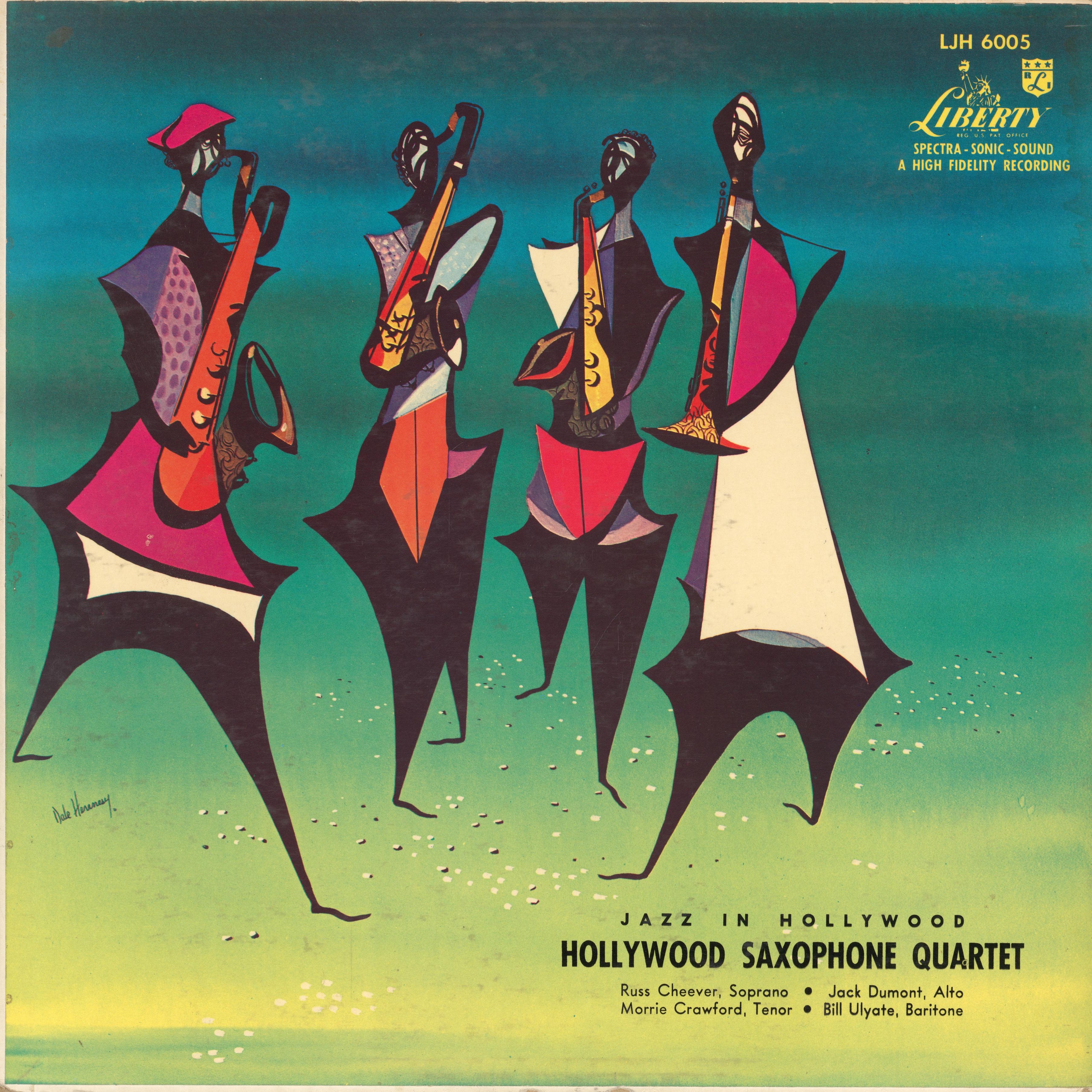
Hollywood Saxophone Quartet
Jazz In Hollywood
✤Liberty LJH 6005✤

For even the most avid and best-informed jazz aficionados, the music in this album may be a huge surprise — and reed players, too, will find much to astonish and delight. The Hollywood Saxophone Quartet was composed of four gifted studio saxophonists, who organized the unit mainly to play original music by contemporary composers with a rhythm section added. In a collection of beautifully played arrangements written by some superbly skilled craftsmen such as Lennie Niehaus, Marty Paich, Russ Garcia, and Jack Montrose, the shadings of tone these men achieve are incredibly delicate and profuse in their colorings. The sheer technical ability, ensemble work, rapport and execution is remarkable — and they swing all the way through. *Jordi Pujol*

As Charlie Emge's liner notes point out, the Hollywood saxophone quartet has suceceded in "creating a true ensemble, an ensemble comparable to that of the fine string quartets". This is not the sax ensemble work of the type that Paul Whiteman used to feature, or even Stan Kenton on Opus in Pastels. It is a collection of beautifully played arrangements that were written by some mighty skilled craftsmen, and which come much closer to the jazz idiom than previous efforts.
The saxes are Russ Cheever, soprano; Jack Dumont, alto; Morrie Crawford, tenor, and Bill Ulyate, barritone, and their rapport and execution is most remarkable.
But there is no room open for improvisation, and though the writing generally is interesting, only Marty Paich's Toccata makes the men extend themselves and presents them with a real challenge. Billy May's Cheek to Cheek contains some genuine humor, Russ Garcia's Commotions is worth hearing, and Lennie Niehaus' Make the Most shows some good construction, but perhaps it would have been wiser not to term this a jazz album. For judged on the basis of its musical creativity it could not merit more than three stars. If judged on sheer technical ability and ensemble work, it would get the full five. Thus the compromise rating. Recording quality is superb.
*Jack Tracy (Down Beat, November 30, 1955)*

The saxophone, from Weidoeft to Trumbauer to Parker, has been subject to widely varying conceptions by performers good and bad. As a result, it is difficult for both teachers and players to say to a student with conviction:
"This is the right (or wrong) way to play saxophone".
In the Hollywood Saxophone Quartet, one hears, in my opinion, the four instruments represented — straight soprano, alto, tenor and baritone — played in a manner that establishes a standard. Not only have its members established a standard for individual performance, but they have succeeded in creating a true ensemble, an ensemble comparable to that of the fine string quartets. It didn't happen over-night, nor by chance. The members of the quartet, all successful career musicians, formed the unit some years ago solely for the purpose of playing music for their own enjoyment and for those persons fortunate enough to hear them at private gatherings. 
⁂
Now that the word "jazz"’ has become more meaningless than ever — it was always the wrong word for the wrong music — I hesitate to use it in relation to the music offered in this album. However, for those who understand that "jazz" is an influence rather than something separate and apart from other forms of music — an influence present to a degree in most forms of contemporary musical expression — the music presented here by the Hollywood Saxophone Quartet could very well open a new world of musical enjoyment. *Charles Emge (liner notes)*

Side 1
1 - Toccata In F
(Paich)
2 - Nightcap
(Niehaus)
3 - New York City Ghost
(Victor Young, Peggy Lee)
4 - You Brought A New Kind Of Love
(Fain, Kahal, Norman)
5 - Autumn In New York
(Vernon Duke)
6 - There'll Never Be Another You
(Jacobs, Tinturin)

Side 2
7 - Mixed Commotions
(Russ Garcia)
8 - Cheek To Cheek
(Irving Berlin)
9 - Make The Most Of It
(Niehaus)
10 - Ghost Of A Chance
(Crosby, Washington, Young)
11 - All The Things You Are
(Kern, Hammerstein)
12 - Dancing On The Ceiling
(Rodgers, Hart)

Russ Cheever (soprano sax), Jack Dumont (alto sax), Morrie Crawford (tenor sax),
Bill Ulyate (baritone sax), Mike Rubin (bass), Dick Cornell (drums).
Recorded at Capitol Studios, Hollywood, California, September 8 and 14, 1955

Thursday, April 3, 2025

Liberty Records • Jazz in Hollywood Series (II)

Dom Frontiere Sextet
Dom Frontiere And His El Dorado
✤Liberty LJH 6002✤

Dominic Frontiere (1931-2017) had barely turned four when he began learning the basic accordion technique. Having mastered his instrument through his classical studies, Dom became interested in modern music. In 1950, he moved to Hollywood, where he lost no time in establishing himself, not only as the leading accordionist in the movie industry but as a composer and arranger as well. He also appeared playing in several films, but 1955 brought him something special.
In March, Dom was signed to a term recording contract with Liberty Records, which led to his first album recording as a leader in the summer, conducting a sextet made up of renowned fellow Hollywood studio musicians. The album came out in the fall with the title Dom Frontiere and his El Dorado.
 His skill with the accordion was indisputable. "In the hands of a master [the accordion becomes] much more than a polka party instrument", Down Beat magazine admitted.
Starting in 1960 and over twenty years, the scores he penned for popular TV series and films, garnered him awards and international recognition as the firstrate composer he was.
This young instrumentalist and arranger revealed his talent and personal approach to the world, by skillfully blending the harmonies of classical music with the rhythm and improvisation of jazz. Dominic Frontiere and his stimulating musical confreres bring us a varied repertoire of well known melodies and originals in their own spirited, happy and swinging way. *Jordi Pujol*

When LIBERTY gave me the test pressing of this album I took it to the radio station with me and played it for engineers, announcers, salesmen, writers, maintenance men and anyone who might be wandering through the halls. I took it home and played it for my wife. I asked my best friend, a fellow jazz enthusiast, to come over and hear it. We played it along with recordings of other accordionists... we turned it up and listened to every note for musicianship, balance, fidelity... we played it in the background 
for atmosphere effect. After I felt I had thoroughly "tested" this finished product I recalled Dom’s words that "an accordionist is only as good as his instrument". It might be interesting to note that six different accordions were tested before a decision was made as to which produced the best sound. The instrument that won out was the custom-made Gretsch "El Dorado" the prototype which is now in full scale production.
⁂
No matter how you play this album — softly in the background while having dinner, or volume wide open on a hi-fi set — it's great! If you like classical music you'll be impressed with the technique and charmed by the humor; if you're a "pop" fan you'll find this as wonderful for dancing as it is for what might be called "putting on a good stack of records"; and if you're a jazz enthusiast... you'll FLIP! *Jack Wagner (liner notes)*

Side 1
1 - Mr. B
(Bach, Frontiere)
2 - Poinciana
(Simon)
3 - Leap For Joy
(Frontiere)
4 - September In The Rain
(Warren, Dubin)
5 - Perpetual Motion
(Paganini)
6 - Tenderly
(Gross, Lawrence)

Side 2
7 - Nola
(Arnt)
8 - Breeze And I
(Lecuona, Stillman)
9 - I'll Be Seeing You
(Fain, Kahal)
10 - Where's The Melody
(A Variation Of 24th Caprice By Paganini)
(Paganini, Frontiere)
11 - Beguine For Bette
(Frontiere)
12 - My Heart Stood Still
(Rodgers, Hart)

Dom Frontiere (accordion), Abe Most (clarinet), Bill Ulyate (bass clarinet),
Jack Marshall (guitar), Mike Rubin (bass), Nick Fatool (drums).
Recorded at Capitol Records, Hollywood, California, between July and August, 1955